Thursday, April 18, 2013

A Trusted Advisor

When our company was making plans to install several 18,000 gallon propane storage tanks in the late 70's, my wife asked, "What do you think the neighbors will say?" Because she was not directly involved in the business, I politely ignored her question. When the tanks were finally delivered to the site, we were suddenly engulfed in a great deal of opposition. It became a big story in the local newspapers and on TV. We were sued by our neighbors which started a grueling six year court process. The public was divided into three groups: those who supported us, those who didn't care and those who felt that we were getting what we deserved. It was a strain on all of us. We eventually won the court case as well as the appeal.

At one point during this arduous process, I asked my wife, "Didn't you say something when we first started, about how the neighbors might react?" She just smiled sympathetically. Listening to your wife's cautions is a critical part of making  wise business decisions. And it is a subject that you may never hear about in any business curriculum.

If this had been the only time that I had ignored my wife's cautions, I might have thought it was just a lucky guess on her part. But, time after time, I have gotten what I thought were brilliant ideas, ignored her warnings and found myself in some sort of trouble. This pattern has also been repeated by others that I have known.  
They usually have no idea why some of their projects have failed.

Another time, my wife and I met a local businessman at a social event. On the way home, she said, "I don't trust him". He seemed harmless enough but several months later, it became apparent that she had been right. So now, I keep a respectful distance from him.

So, before you make that next major business decision, be sure to run it by your most trusted advisor.

The 80/20 Rule

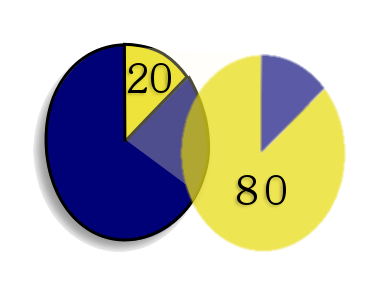
When we plotted our propane sales on an Excel spreadsheet a few years ago, we were very surprised at what we discovered: 85% of our business was home heating and 15% was everything else. The "everything else" included temporary construction heat, a small amount of forklift cylinder delivery, some single small appliance use (stove or dryer) and various other applications. It was Pareto's 80/20 Rule almost to the letter.

It became obvious that our home heating accounts were our ideal customers. A very small segment of our business activity was taking more than 80% of our time and resources. When I mentioned this revelation to the delivery guys, they were already aware of it. (I guess I was destined for management.)

We decided to concentrate on the 85% that yielded the best return and began to eliminate the 15%. When we started in this new direction, the other people in the office thought I was crazy. And for a time, I thought they might be right.

Several things happened as a result. Our labor costs dropped because we were no longer getting phone orders at the last minute for temporary heating deliveries or other low margin activities that only made us look busy.  Profitability went up and the stress level in the office dropped dramatically because the business that we were now focusing on could be planned ahead of time. 

Even though your market mix is probably different from ours, the principle remains the same. Determine your ideal customer and focus on them for your best return on investment.  

Follow Your Own Recipe

My wife's grandmother used to cut off the ends of a ham before putting it in the oven. This went on for years. As a result, everyone in our family prepared hams the same way. After Grandma passed away, my wife became curious and wondered what the secret was to cutting the ends off before baking. When she asked her aunt, she replied, "Her pan was too small so she had to cut the ends off to fit in the pan."

Those of us in business do the same thing. We copy competitors because we assume their methods must be right for us as well. Not true.

For example, when we first started sending newsletters to our customers, I copied the way a large competitor was doing theirs by putting on a tie and placing my photo on the front page. After the first edition, a friend suggested that I get rid of the tie and just be honest about who we were. He suggested that we replace the photo with a casual shot of me and my dog. He explained that when he had added pets to the web sites of his clients, traffic increased considerably. Then, he asked if I had a cat. "No, but I could rent one!" He dismissed the idea and convinced me to be honest and stick with the dog.

I began to include articles about mistakes that I have made as a husband over the years, which insured a wealth of material. The more I revealed about myself, the better the feedback from our customers. It was a risk worth taking.

Instead of blindly conforming to the way other companies do business, take pleasure in being as different and unique as you can possibly be. Be yourself!
 

Define Your Goals


Steven Covey conducted a survey of over 23,000 employees across a wide range of companies and industries which revealed the price of not communicating the vision and goals to our company's employees:

  • Only 17% said they have a clear understanding of what their organization is trying to achieve and why
  • Only 20% were enthusiastic about their team's and organization's goals
  • Only 20% said they had a "clear line of sight"  between their jobs and their team's and organization's goals
  • Only 15% felt that their organization fully enables them to execute key goals
  • Only 20% fully trusted the organization they work for*
If your company were a five-year-old soccer team, the lack of communication of the company's vision and goals would look like this:
  • Only 2 of the 11 players on the field would know which goal is theirs and how to score a goal
  • Only 2 of 11 would care
  • Only 2 of 11 would know what position they play and what they were suppose to do
  • Only 2 would feel they had the coach's ok to kick the ball
  • And all but 2 would be keeping the ball from their own team members rather than the opponent
 *Courtesy Rick Wallace (Next Level Coaching)

When our organization is without clearly defined goals, we just do busy work all day. However, when we know where we are headed and we effectively communicate that to our staff, we become more effective and are able to move our company forward as a team.

Tuesday, August 21, 2012

And The Survey Says...


And The Survey Says...


Whenever I am asked for feedback from a hotel or restaurant, I fill it out right away and eagerly relay my experience to them. It is important for people in business to understand and appreciate the significance of customer feedback. At first, I was hesitant to consider asking our customers for feedback. After all, why would I deliberately ask someone to take their best shot at me? (I bruise easily.)

There are two common mistakes companies make when asking customers for feedback. Surveys are often ignored because they are either too lengthy or worded in such a way that doesn’t allow you to honestly express your opinions. For example, I received a survey from an organization that I belong to. I had been frustrated about some things and was ready to spell it out to them in a forceful, yet polite way. To my disappointment, the survey was limited to multiple choice questions which failed to address any of the “elephant in the living room” problems that were plaguing the organization. Ugh!

We have discovered a better way. Once a year, we send a survey to our customers via email and ask only one question:“On a scale from 1-10, how likely are you to recommend our company to someone else?” And then we ask them to explain their answer. It’s that simple! The first time we did this, it was like asking your mother-in-law if she sees anything in you that she would like to change. (Note: My mother-in-law did not receive a copy of the survey.) The customers who gave us a rating of 8 or above were the customers that were most likely to refer us to others whenever possible. The ones who gave us a score of 1-5 were most likely to switch to another company in the near future.

We called the customers who gave us a low score and asked them to explain their reasons for doing so. After allowing them to tell us the whole story, we authorized the person making the calls to do whatever they felt was necessary to correct the situation right away. We then called the customers who gave us a high score. After thanking them, we asked for permission to use their comments on our web site and other advertising pieces: http://www.reliablepropane.com/Testimonialpage.

I haven’t completely overcome my fear of customer feedback yet, but I now realize the vital role it plays in the health of any organization that wants to serve its customers in meaningful ways.

Friday, April 13, 2012

60 Minutes

"One hour of uninterrupted time is worth three hours
of time that is constantly interrupted."

-Steve Chandler

60 Minutes

I was challenged recently to close my office door, eliminate all distractions and concentrate on a particular project for one hour. It just didn't make sense to me, because I was already overwhelmed with one thing after another and didn't want to waste any more precious time. Because I was desperate, I decided to try it. The first twenty minutes were the worst. I scanned my desk which was covered with unfinished tasks; people to call, memos to be forwarded, etc. I had to force myself to keep my eyes off the activity on the security monitors as well as resist the relenting desire to check e-mail.

Eventually, I was able to settle down, concentrate on the project and complete it. The hour of uninterrupted time was well worth the effort. When I opened my office door and headed for the reception area, I felt as though I had already done a day's work. I had a genuine sense of accomplishment plus a renewed sense of energy.

Do you find yourself working hard from morning until night but at the end of the day asking, "What have I really accomplished today?" Schedule an hour. Apply slow, steady, concentrated effort to your project and keep that appointment (with yourself) like you would with your doctor. You will discover that you will be able to look at the big picture and create solutions to big picture projects.

Friday, December 16, 2011

Christmas Bonus

 Christmas Bonus
For years, we have paid our employees Christmas bonuses. Each year, we felt we were obligated to increase the amount until it grew out of control. I postponed the solution because I was worried that a change would upset people. I know, I'm a chicken. One Christmas we were low on cash and had no choice but to reduce the bonuses significantly. So the following year, we made the move. We let everyone know that we were making a change so they would not be expecting the extra check.

Instead, we tied financial rewards to each tank that we set for a new customer. All full time employees receive a small financial reward for each completed, new customer tank set. (Only 500 and 1000 gallons tank are counted.) The total is added to the last payment period of the month. This has removed the pressure of deciding who gets what and focuses everyone's attention on new business.

At our office Christmas party, instead of handing out bonus checks, we wrap candy bars or gift certificates and pass them out to each employee as "awards" after a brief, humorous story of what we appreciate about each person.

Now the only thing I have to stress about is what to get my wife for Christmas!